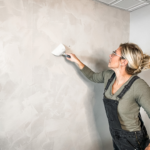
Roman Clay Wall Application
With care and attention, a wall application can completely transform a room. I love what Roman Clay has done for our home, and I'm excited to see your results!
Equipment
- 2 Old buckets or 1 flat painting tray (works best if one is a square bucket)
- Drill mixer
- Drywall compound (wet or dry)
- Paint color of choice
- Putty Knife (aka metal or plastic scraper)
Instructions
Prepare Drywall Compound
- Mix a few cups of drywall mix and water together with a drill mixer. Think of this as making batter - blend well and make sure there are no lumps (otherwise you will have dry powdery residue on your wall).
- You can also purchase pre-mixed buckets of drywall mix
Mix in your choice of paint
- In the paint bucket add 1 part of drywall mixture to the 2 parts of paint.
- Mix with drill mixer along the way (I eyeballed this at the start - just make sure to start small and mix well as you go).
- *Important: Add drywall compound to the paint, not the other way around.
Apply Mixture
- Take your putty knife/scraper and apply the mixture in a cross-hatch, crazy 8, or S pattern.
- There is no perfect "Roman Clay technique" just do this until you have covered your entire surface. The idea with the first coat is to completely cover your surface. Our previous wall paint had a glossy finish, so I could tell where I had missed spots or where it didn't cover as well.
Continue applying coats
- Apply a second and possibly third coat (I did 3, but 2 would probably have been sufficient)
Important things to keep in mind
- If you are a fan of very smooth surfaces, you can sand between coats. I chose not to in order to preserve the texture
- Keep in mind the thickness of this Roman Clay will cover less area than if you are just covering the wall with paint.
- You can apply sealer as a "top coat" after you have finished the Roman Clay. However, since ours is in our basement I didn't see a need (the sealer is more applicable if the Roman Clay is in a living room or bathroom).
Notes
Let me know your results and thoughts below!